Selecting and Reconciling Wedding Customs
When two families bring different customs, faith commitments, and expectations to a wedding, the first decision is not which tradition is correct. It is what each proposed stage means, who can decide it, and what must be confirmed before dates, invitations, or vendors are booked.
Blended wedding traditions may involve family introductions, customary ceremonies, religious services, civil registration, guest communication, and several ideas about when a marriage becomes publicly recognized. A workable plan keeps those meanings visible without treating family practice as registry procedure or one household's sequence as a universal rule.

Start with three questions:
- What does the couple want to include?
- What does each family or faith community expect?
- What must be confirmed by the relevant registry, congregation, mosque, church, or other responsible institution?
The answers may lead to one event, several events, or a sequence that combines selected elements while keeping others distinct.
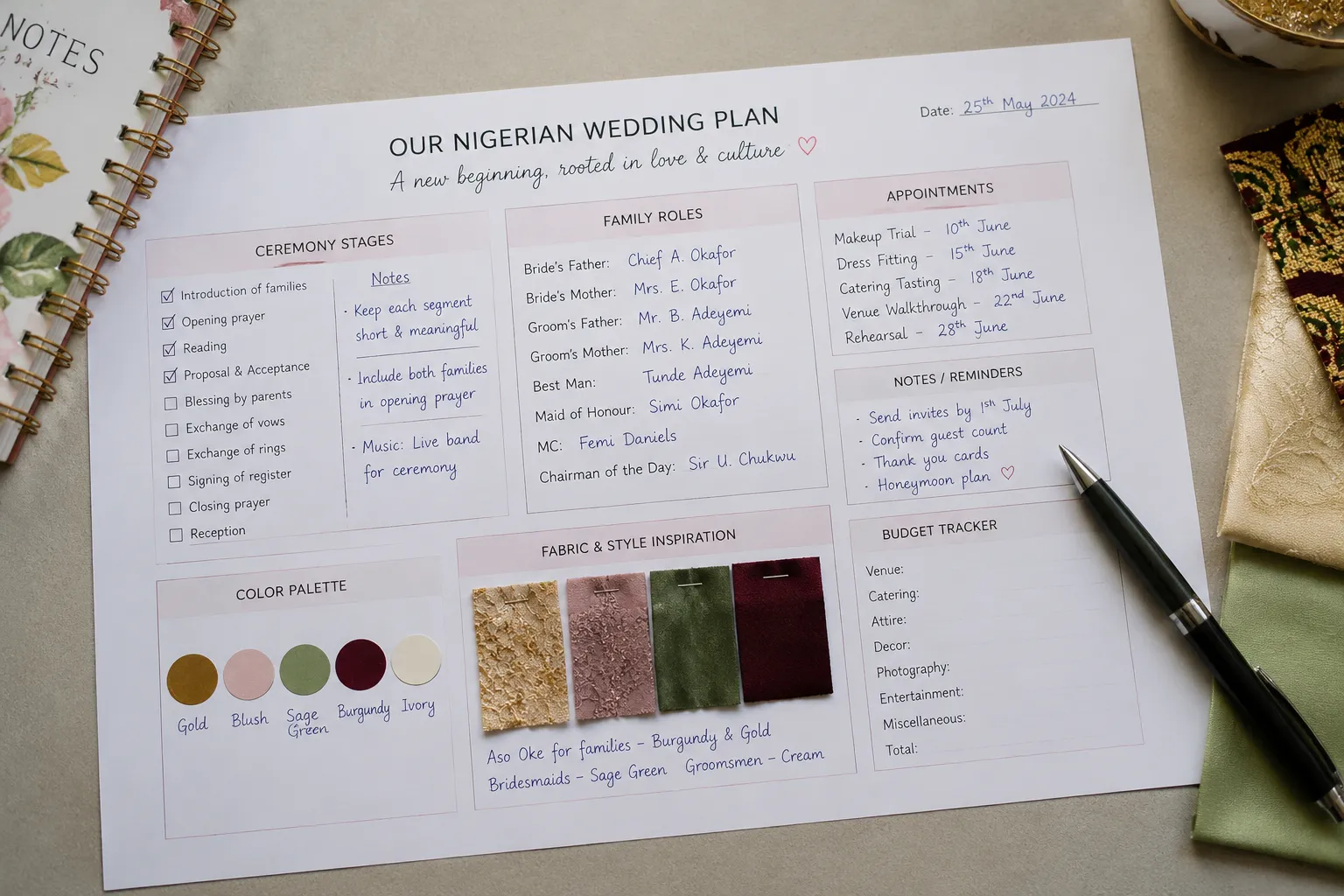
List Every Proposed Ceremony Stage
Before comparing customs, write down every event either family has mentioned. Keep the language relatives use, then add a neutral planning description beside it.
| Proposed stage | Planning category | Main decision owner | Confirmation |
|---|---|---|---|
| Family introduction | Family-led or customary | Both families and the couple | Family representatives |
| Engagement ceremony | Customary or celebratory | The couple and relevant family representatives | Family practice and venue |
| Traditional rites | Customary, family-led, or religious | The responsible family or community | Family representatives and, where relevant, faith leaders |
| Church ceremony | Religious | The couple and congregation | Current congregation process |
| Mosque ceremony or nikah | Religious | The couple and mosque or officiant | Current religious process |
| Registry ceremony | Civil or statutory | The couple and relevant registry | Current registry procedure |
| Reception | Social and celebratory | The couple and host families | Venue, vendors, and guest plan |
This list does not decide what an event means. It prevents different people from using the same word for different purposes.
For example, one family may call an engagement ceremony the wedding, while the couple may treat it as a customary family stage before a church or registry ceremony. Settle that distinction before invitations, travel arrangements, or public announcements are issued.
Separate Family Preferences From Institutional Procedure
Family customs and institutional procedures have different decision-makers. A family may request a particular introduction, gift exchange, outfit, greeting, elder's role, or order of participation. A congregation or registry may have its own current process, documents, appointments, or scheduling conditions.
Available Nigerian material supports this distinction but does not establish one complete sequence for every Nigerian wedding. Check current civil details with the relevant registry or government office, using the Federal Ministry of Interior Nigeria as one government verification route.
A family elder, vendor, general cultural article, or secondary legal reproduction cannot substitute for the institution responsible for current procedure. Record the two kinds of information separately:
- Preference or expectation: “The bride's family would like a formal introduction before the engagement.”
- Institutional point to confirm: “The congregation needs to explain its current marriage preparation process.”
A family preference may be negotiated, adapted, or moved to another event. A registry or faith-body process must be checked with that registry or faith body before the schedule depends on it.
Decide What Each Tradition Is Meant to Do
Two ceremonies can contain similar symbols while serving different purposes for the people attending them. Name the purpose of each proposed stage before deciding whether to combine or change it.
- recognition between the families
- participation by elders or extended relatives
- religious blessing or worship
- customary negotiation or exchange
- civil registration
- public celebration
- inclusion of children, stepfamilies, or relatives abroad
- a shared expression of both partners' heritage
This purpose helps the couple decide whether an element should be retained, adapted, combined, or kept in a separate event. A ceremony may carry substantial family meaning without confirming civil procedure. A registry appointment may address a statutory process while relatives still expect customary or religious recognition.
The practical question is what each group needs that stage to accomplish, and whether the proposed arrangement communicates that purpose clearly.
Assign Decision-Making Standing
Planning becomes difficult when everyone is consulted about everything, but no one knows who can make the final decision. Create a decision-owner list before the first large family meeting.
The couple
The couple should identify non-negotiables, acceptable adaptations, the preferred number of events, and limits on cost, travel, timing, and public participation. They should also agree on what they will explain together when relatives receive different messages.
Each family
Families may hold standing over specific customary stages, introductions, gifts, elders' participation, guest expectations, or the language used during negotiations. That standing can vary by household and community.
Ask each side to name the person who should explain its expectations. One clear representative is more useful than competing accounts from every relative.
The congregation or faith representative
A church, mosque, or other faith body may control its own preparation, ceremony, participation, or scheduling process. Confirm those details directly with the relevant congregation or representative.
Familiarity with a religious practice does not establish the current process of a particular congregation.
The registry or government office
The relevant registry or government office is responsible for confirming current civil procedure. Ask directly about the details that affect the schedule, such as documents, appointments, witnesses, location, and timing.
Public material does not verify one Nigerian process for every location. Do not schedule dependent events around an unconfirmed registry assumption.
Vendors and hosts
A venue, caterer, tailor, photographer, transport provider, or master of ceremonies can coordinate delivery. They do not decide what a family custom or institutional process means.
Give vendors a written sequence after the responsible people have agreed to it.
Compare Options by Dependencies
A useful comparison asks what each arrangement requires before it can happen. Prestige is less helpful than timing, authority, travel, and participant roles.
| Planning option | Potential advantage | Main dependency | Question to settle |
|---|---|---|---|
| One combined event | Fewer travel and venue demands | Several groups must agree on timing and meaning | Can each stage remain understandable within one program? |
| Separate customary and religious events | Each tradition has its own space | More dates, outfits, guests, and coordination | Which event comes first, and how will invitations describe it? |
| Civil event before the celebration | Statutory planning stays separate from the public program | Registry timing and current procedure | What must be confirmed with the relevant registry? |
| Religious event before the reception | The congregation has a defined role | Faith-specific process and scheduling | Which elements belong in the religious setting? |
| Small family stage followed by a larger reception | An intimate family process can remain focused | Clear communication about access and invitations | Which relatives need to attend the earlier stage? |
The suitable arrangement depends on family expectations, faith commitments, registry timing, location, guest travel, budget, and the meaning assigned to each stage. No option should be treated as the default for every couple.
Use Cultural Examples as Conversation Starters
Research on contemporary Igbo Christian marriages discusses stages and terms including Iku aka, Iju Ese, Ika akirika na Ime ego, Igba Nkwu, and Idu uno. It also describes tensions involving family participation, bride-price discussions, traditional wine carrying, church expectations, gender roles, and modern adaptation.
These terms may help a couple recognize the stages relatives are referring to. They do not establish one universal Igbo order or requirement. A family may use some stages, combine them, adapt their presentation, or describe them differently.
General Yoruba cultural material can also provide context for variation in family and ceremonial expectations. It cannot establish a complete Yoruba wedding process or determine what a particular family must do.
Treat the example as a way to identify questions, not as a script. Ask the relevant family representatives what a stage means in their household, who participates, and which adaptations would be accepted.
Reconcile Expectations Without Erasing Meaning
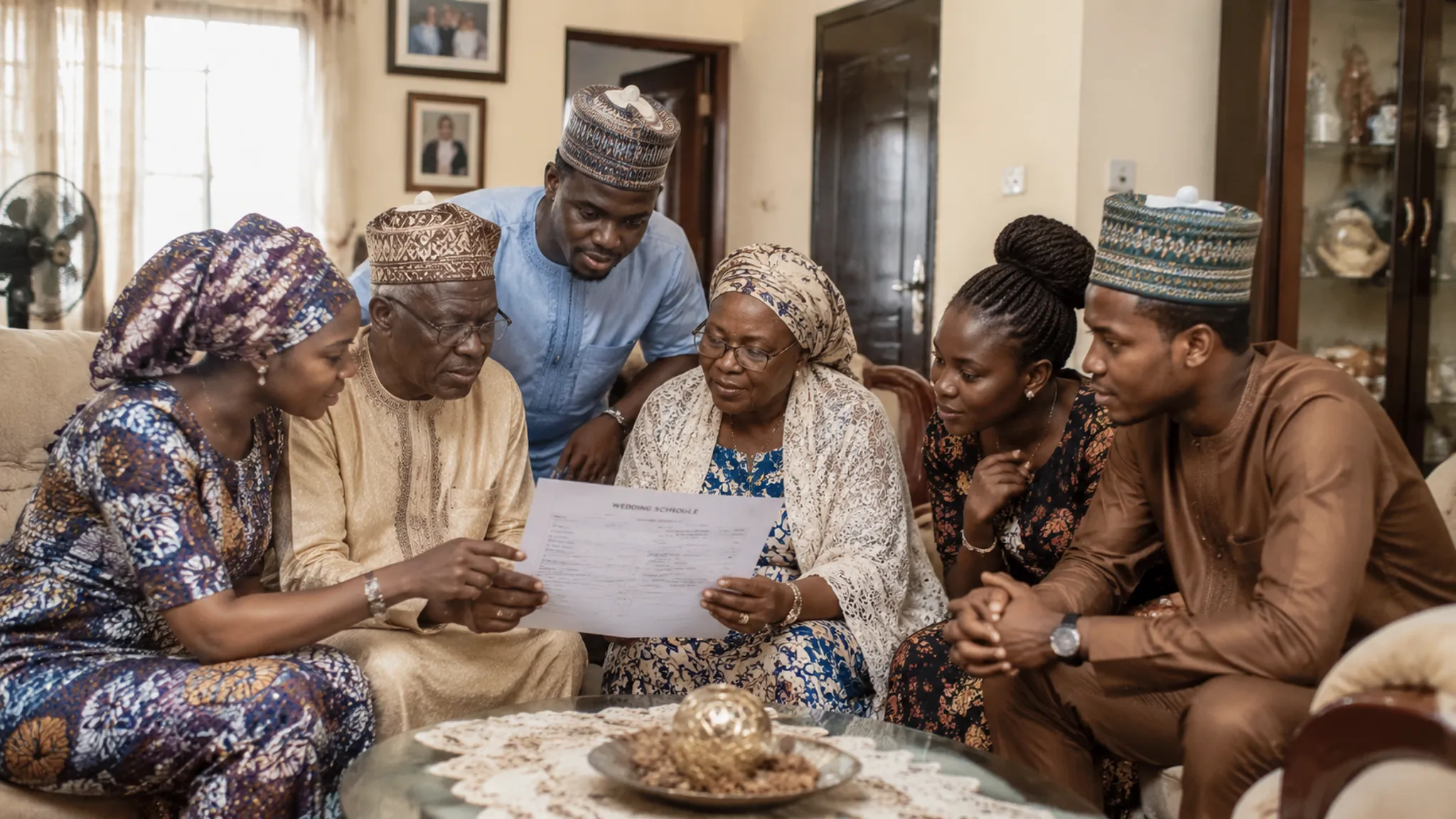
Family conversations usually become more workable when they begin with meaning rather than logistics. Instead of asking whether a part can simply be removed, ask what it communicates and who needs to witness it.
- What does this stage represent for your family?
- Who needs to be present for it to feel properly recognized?
- Which part is essential, and which part could be shortened or moved?
- Would the family accept a smaller version before the larger celebration?
- Does this request come from family practice, religious teaching, or personal preference?
- Who should give the final explanation to relatives?
A couple may preserve family recognition while changing the guest size, location, clothing schedule, or timing. Another couple may keep a religious ceremony separate because combining it with a customary event would make its purpose unclear to participants.
Comparative research on blended and interfaith ceremonies describes adaptation as one planning possibility where couples represent more than one heritage, faith background, or family structure. That research can illuminate negotiation and communication, but it does not establish a Nigerian rule. The decision still belongs with the couple, families, and relevant institution.
Build One Possible Sequence
A sequence should show dependencies and decision owners. It is a planning example, not a universal order.
Agree the couple's non-negotiables
List the traditions, religious elements, family stages, guest roles, and public commitments each partner considers important. Mark each item as retain, adapt, discuss with family, confirm with an institution, or undecided.
Meet the relevant family representatives
Share the proposed list with the people responsible for each family's expectations. Ask them to explain the meaning, participants, timing, and acceptable adaptations for each stage. Record disagreements as separate decisions rather than reducing them to “traditional” versus “modern.”
Consult the congregation or faith representative
Confirm the current process directly. Ask which elements may occur during the religious ceremony and which should be placed elsewhere. Also ask whether preparation meetings or additional scheduling steps apply.
Verify the civil track
Contact the relevant registry or current government office for the applicable procedure. Confirm the details that affect the schedule, including documents, appointments, witnesses, location, and timing.
Keep this track separate in the planning document. A customary or religious agreement should not be treated as confirmation of registry procedure.
Resolve dependencies before booking
Check family availability, elder participation, congregation scheduling, registry availability, travel between locations, outfit ordering, guest communication, vendor access, and venue timing. Some decisions can happen in parallel. Others cannot.
Publish one shared version
After the responsible people agree, create a short schedule using consistent names for each event. State who is invited, what the event represents, where it happens, and who should answer questions.
This shared version is especially useful for diaspora weddings, where relatives may coordinate flights, accommodation, clothing, gifts, and leave from work.
Keep Variation at the Right Level
Variation may come from family background, location, religious commitments, congregation practice, the role assigned to elders or kindred, relatives living abroad, combined stages, or the couple's chosen adaptations.
Do not use a general description of Yoruba, Igbo, Hausa/Fulani, Muslim, Christian, or customary weddings to predict one family's exact expectations. A more useful statement is specific and limited: “This family expects an introduction before the larger celebration,” or “The congregation has asked the couple to complete a separate preparation step.”
The person or institution responsible can then confirm whether that expectation applies to the current plan.
Keep Guest Communication Precise
Guests often confuse several events when invitations use one broad word for the entire wedding. For each invitation or announcement, identify:
- the event name used by the family
- whether it is family-led, customary, religious, civil, or celebratory
- the date and location
- the guests expected to attend
- clothing or gift guidance
- whether the event forms part of a larger sequence
Do not suggest that one stage automatically replaces another unless the responsible family or institution has agreed to that description. The same care applies to photographs, program notes, social media announcements, and speeches.
Common Planning Confusions
Calling a customary ceremony a registry appointment
A family ceremony may carry substantial social meaning, but that does not confirm current civil procedure. Check the registry track directly.
Calling a registry ceremony the complete wedding for everyone
A civil event may meet the couple's immediate purpose while relatives still expect customary or religious recognition. Discuss what each group considers unfinished.
Assuming one family's practice represents an ethnic group
Documented examples are useful for vocabulary and context. They do not establish one order for every Yoruba, Igbo, Hausa/Fulani, Christian, Muslim, or diaspora family.
Asking a vendor to settle a family disagreement
Vendors can work from an agreed brief. They should not decide whether a stage is customary, religious, or institutionally required.
Scheduling before confirming the decision owner
A date may suit the couple but fail for the registry, congregation, elders, or relatives whose participation is necessary. Confirm responsibility before paying deposits.
A Reconciliation Worksheet
Use one row for each ceremony stage or requested custom.
| Item | Who values it? | What does it mean? | Can it be adapted? | Who confirms it? | Dependency |
|---|---|---|---|---|---|
Then mark each item as a couple decision, family discussion, congregation confirmation, registry confirmation, vendor coordination, or open question. This keeps cultural preference, institutional procedure, and event logistics from collapsing into one argument.
Finish with four agreed statements:
- The events we are holding are:
- The person responsible for each family stage is:
- The institution responsible for each current procedure is:
- The detail we will not announce until confirmed is:
That final line is useful when documents, appointments, religious participation, or family decisions remain unresolved.
Questions to Ask Before Setting the Date
- Which stages does each family expect, and what does each stage represent?
- Who should attend or speak for each family?
- Which customs are essential to the family, and which can be adapted?
- Does the couple want one combined event or separate ceremony stages?
- What does the church, mosque, or other congregation require for its own ceremony?
- Which civil details must be confirmed with the relevant registry?
- Does the proposed order create confusion about what each event represents?
- Which guests need to travel for an earlier family stage?
- What must be ordered, tailored, distributed, or scheduled first?
- Who will send the final explanation when relatives ask what has changed?
A strong plan explains what is being preserved, what is being adapted, what remains separate, and who confirmed each part. Keep civil registration on its own verification track, and let each family or institution explain the stages within its standing.
Before booking, name the unresolved confirmation, its owner, and the timing consequence. That handoff is what turns blended wedding traditions into a sequence the people involved can understand and carry out.
Sources
- Federal Ministry of Interior Nigeria
- Yoruba Marriage Traditions
- Ethical Dilemmas in Contemporary Igbo Christian Marriages: Navigating Modernity and Cultural Identities
- Choices and Constraints Where Couples Do Not Share Religious Beliefs
- Independent Celebrant-Led Wedding Ceremonies: Translating, Tweaking, and Innovating Traditions